
Advancing Wheelchair-Mounted Assistive Robotics with xArm 6
UWM BioRobotics Lab
In Short
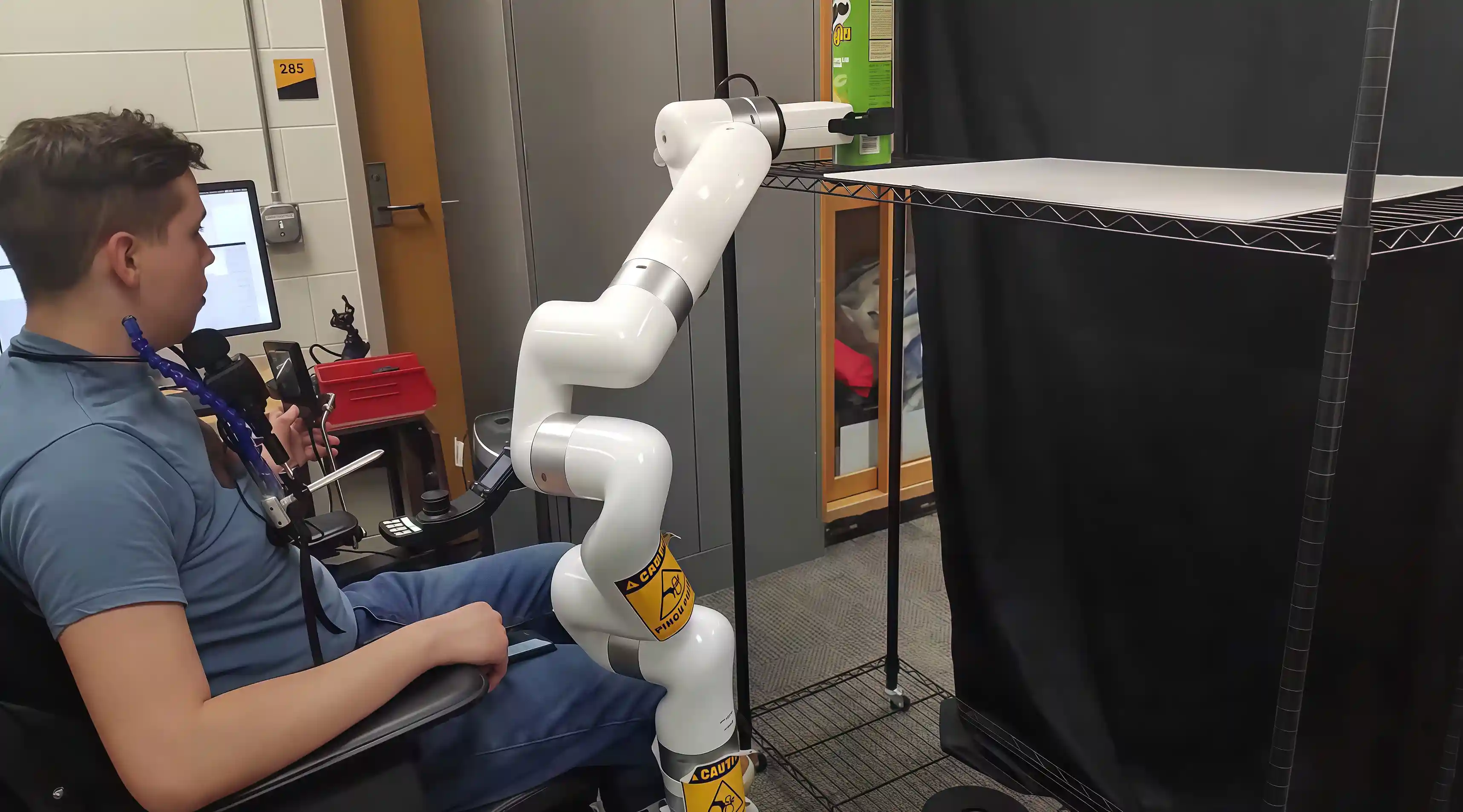
Since 2021, the BioRobotics Lab at the University of Wisconsin–Milwaukee (UWM) has conducted a sustained research program in wheelchair-mounted assistive manipulation, using the xArm 6 as its core hardware platform. The work spans eye-gaze control, joystick-based interfaces, and vision-guided semi-autonomous manipulation, resulting in two peer-reviewed papers and one master’s thesis to date.
Customer Profile

Organization:
UWM BioRobotics Lab

Industry:
Research & Education

Region:
USA

Robot Used:
UFACTORY xArm 6

Application:
Wheelchair-Mounted Manipulation
Key Benefits
DOF for real-world ADL tasks
Compact and lightweight, wheelchair-mountable
Affordable for university research budgets
Open Python & C++ SDKs for custom control Reliable for sustained, multi-project use
RS-485 / Modbus RTU with multi-mode closed-loop control
Task Solved
Built a multi-modal wheelchair-mounted arm control system (mR2A) enabling users with varying motor abilities to independently perform daily tasks.
Benefits Achieved
Eye-gaze control: 100% task completion.
Joystick control: ~5mm accuracy, 4ms latency, 100% completion.
Vision-based semi-autonomy: 47 object categories, 72.9% success rate.
Two peer-reviewed papers and one master’s thesis to date
Research Timeline & Results
2021 — Eye-gaze control of a wheelchair mounted 6DOF assistive robot for activities of daily living
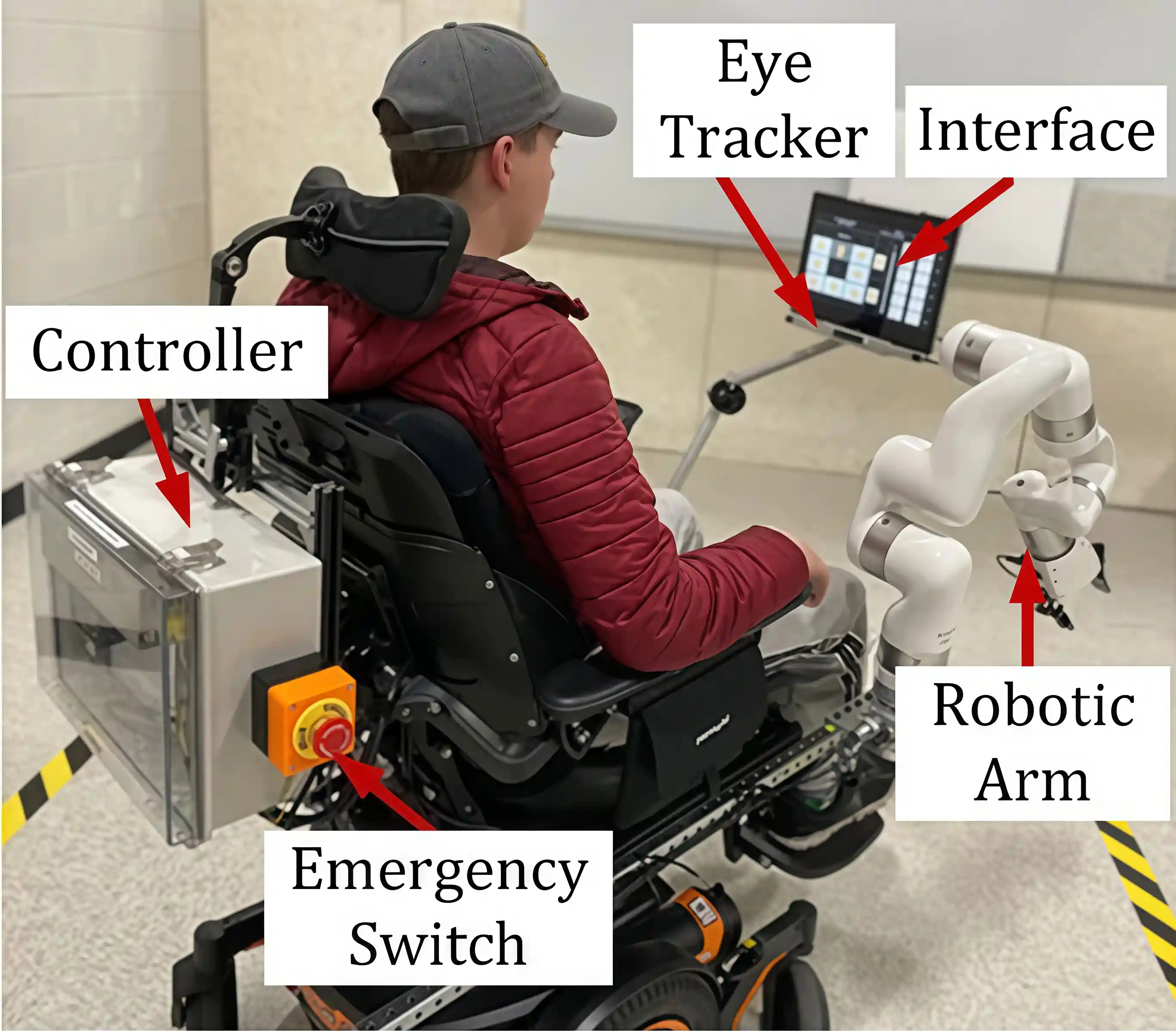
The team developed an eye-gaze interface allowing users to control both the wheelchair and the xArm 6 using only eye movements. Ten healthy participants completed three categories of pick-and-place tasks, achieving a 100% task completion rate in an initial feasibility study.
https://pmc.ncbi.nlm.nih.gov/articles/PMC8684692/
2022 — Control of a Wheelchair-Mounted 6DOF Assistive Robot With Chin and Finger Joysticks Frontiers in Robotics and AI
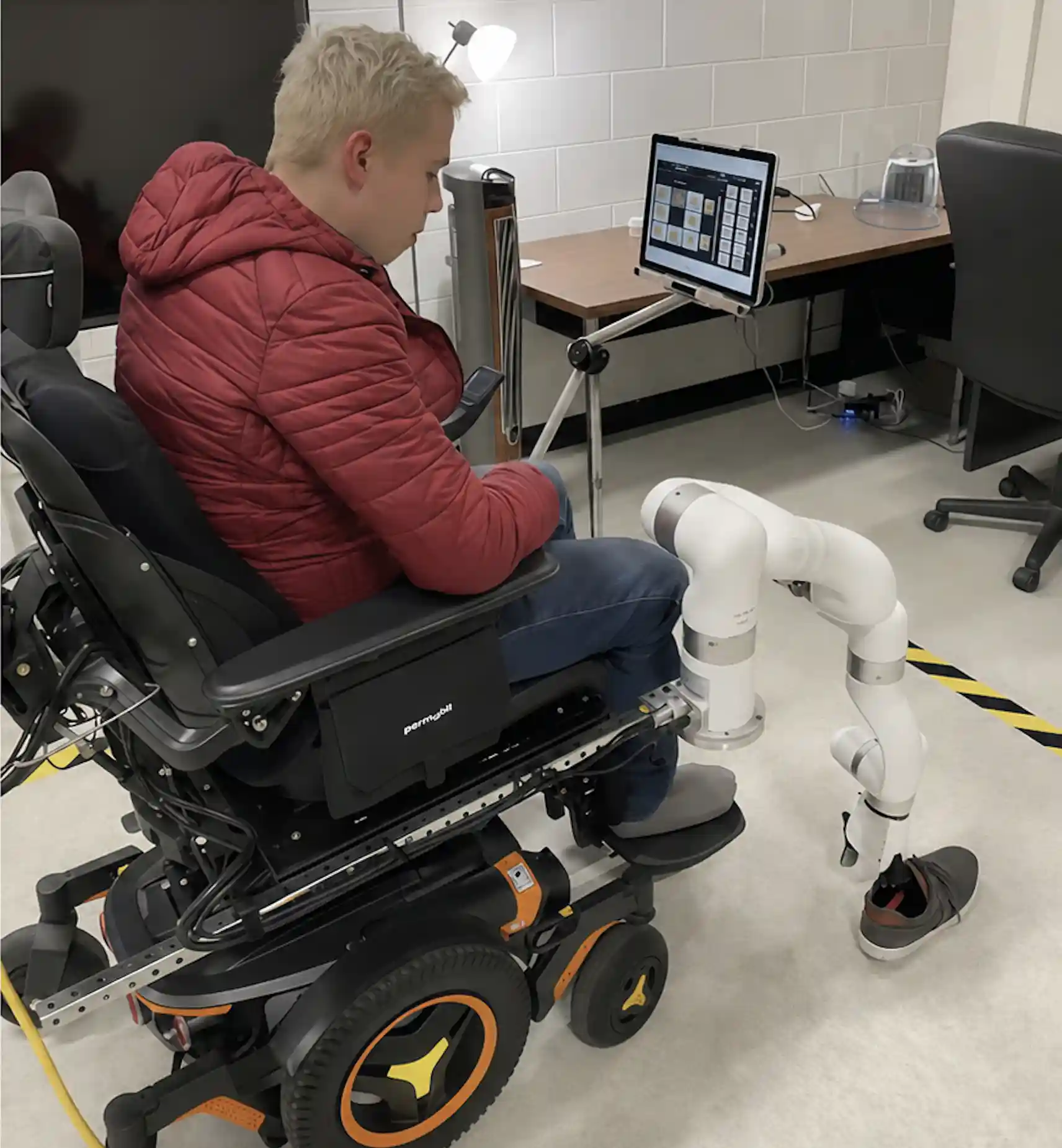
A unified control framework was developed supporting both finger and chin joystick inputs, with seamless mode-switching between wheelchair navigation and arm manipulation via a single joystick. Under varying speeds and payloads ranging from 1 to 3.5 lbs, the system achieved an absolute position accuracy of approximately 5 mm and a round-trip command latency of 4 ms. Ten healthy participants completed three pick-and-place task types, each repeated ten times — all tasks were completed within one minute, with a 100% completion rate.
UFACTORY engineers Tony Leheng and Jason Peng Longxiang are listed as co-authors on this publication. https://pmc.ncbi.nlm.nih.gov/articles/PMC9354078/
2023 — Vision-Based Object Manipulation for ADL Assistance Using Assistive Robot UWM
An Intel RealSense D435 depth camera and a YOLO object detection model were integrated with the xArm 6 to enable real-time recognition, 3D localization, and semi-autonomous grasping of everyday objects. The system covers 47 ADL-relevant object categories and achieved an overall task success rate of 72.9%. This master’s thesis marked the lab’s transition from fully manual control toward semi-autonomous operation.
https://minds.wisconsin.edu/handle/1793/93239
Why UFACTORY xArm 6?
To accelerate algorithm development and overcome the limitations of early-stage prototype hardware, the lab needed a robot arm that could serve as a reliable testbed before solutions were ported back to the mR2A platform. Specifically, the team required a manipulator that:
1. Offers sufficient degrees of freedom to execute real-world ADL tasks
2. Is compact and lightweight enough to mount on a powered wheelchair without compromising balance or maneuverability
3. Fits within a university research budget
4. Provides open Python and C++ SDKs, enabling the team to build custom control frameworks and integrate diverse input methods including joysticks and eye-gaze trackers
5. Delivers the hardware reliability needed for sustained, multi-project use
6. Supports RS-485 communication and Modbus RTU protocol, with closed-loop control across current, torque, velocity, and position modes
xArm 6 met all six requirements.
Not sure which model fits your workflow?
Our team will match the right robot and configuration to your needs.